After Orbán: Hungary's Election Breaks a €90bn Deadlock
On April 12, 2026, Viktor Orbán — one of the EU’s longest-serving and most disruptive leaders — lost Hungary’s parliamentary election to Péter Magyar’s Tisza party in a landslide. Within two weeks the result had unlocked a €90bn ($106bn) EU loan to Ukraine that had been frozen for months, after a sequence of events involving a damaged oil pipeline, a diplomatic trade-off, and an emergency session of EU ambassadors in Brussels.
Who Was Viktor Orbán, and Why Did He Matter to the EU?
Viktor Orbán had governed Hungary since 2010, building a centralised state he called “illiberal democracy.” His governments steadily eroded judicial independence, press freedom, and academic autonomy — earning repeated censure from Brussels and the suspension of billions in EU cohesion funds. Inside EU meetings, however, he wielded Hungary’s single veto as a weapon. He repeatedly blocked or delayed EU foreign-policy decisions on Russia and Ukraine, citing Hungary’s energy dependency and what he framed as a defence of Hungarian sovereignty.
After Russia’s full-scale invasion of Ukraine in February 2022, Orbán remained conspicuously close to Moscow. He opposed arms deliveries channelled through EU mechanisms, sought Russian gas exemptions, and, most recently, blocked a €90bn macro-financial assistance loan to Ukraine — the largest single financial commitment the EU had ever proposed for a partner country.
The Election: Magyar’s Landslide
With 97% of precincts counted, Magyar’s Tisza party secured 138 seats in the 199-seat National Assembly on 53.6% of the vote. Orbán’s Fidesz won just 55 seats with 37.8%. Turnout exceeded 77% — a record for post-communist Hungary. The margin gave Magyar a two-thirds supermajority, theoretically enough to amend Hungary’s Fundamental Law.
Orbán conceded on election night, ending 16 uninterrupted years in power.
Who Is Péter Magyar?
Magyar, born in Budapest in 1981, was himself a Fidesz insider for much of his adult life. He holds a law degree from Pázmány Péter Catholic University and worked as a diplomat at the Hungarian Foreign Ministry, then as director-general of the State Student Loan Centre, and later at the Hungarian Development Bank — all positions within the Orbán-aligned establishment.
The break came in February 2024, when President Katalin Novák granted a presidential pardon in a child-abuse case. Magyar publicly resigned all government-affiliated roles in protest, then on 15 March 2024 — Hungary’s national day — announced he would challenge Orbán from the inside. He took over the little-known Respect and Freedom (TISZA) party and in the June 2024 European Parliament elections came second nationally, winning nearly 30% of the vote. Two years later his party swept the national election.
Magyar describes himself as a conservative liberal and “critical pro-European.” He has been explicit that, unlike Orbán, he intends to unblock EU funding for Ukraine and repair Hungary’s fractured relationship with Brussels.
The Druzhba Pipeline: Oil as a Bargaining Chip
Even with Magyar’s election victory, the path to the EU loan ran through an unlikely bottleneck: an oil pipeline called Druzhba.
Druzhba (дружба) means “friendship” in Russian — a name that has aged awkwardly. At over 4,000 km it is one of the world’s longest pipelines, carrying crude oil from the Samara region of Russia westward across Belarus and Ukraine into Central Europe. It splits into two branches:
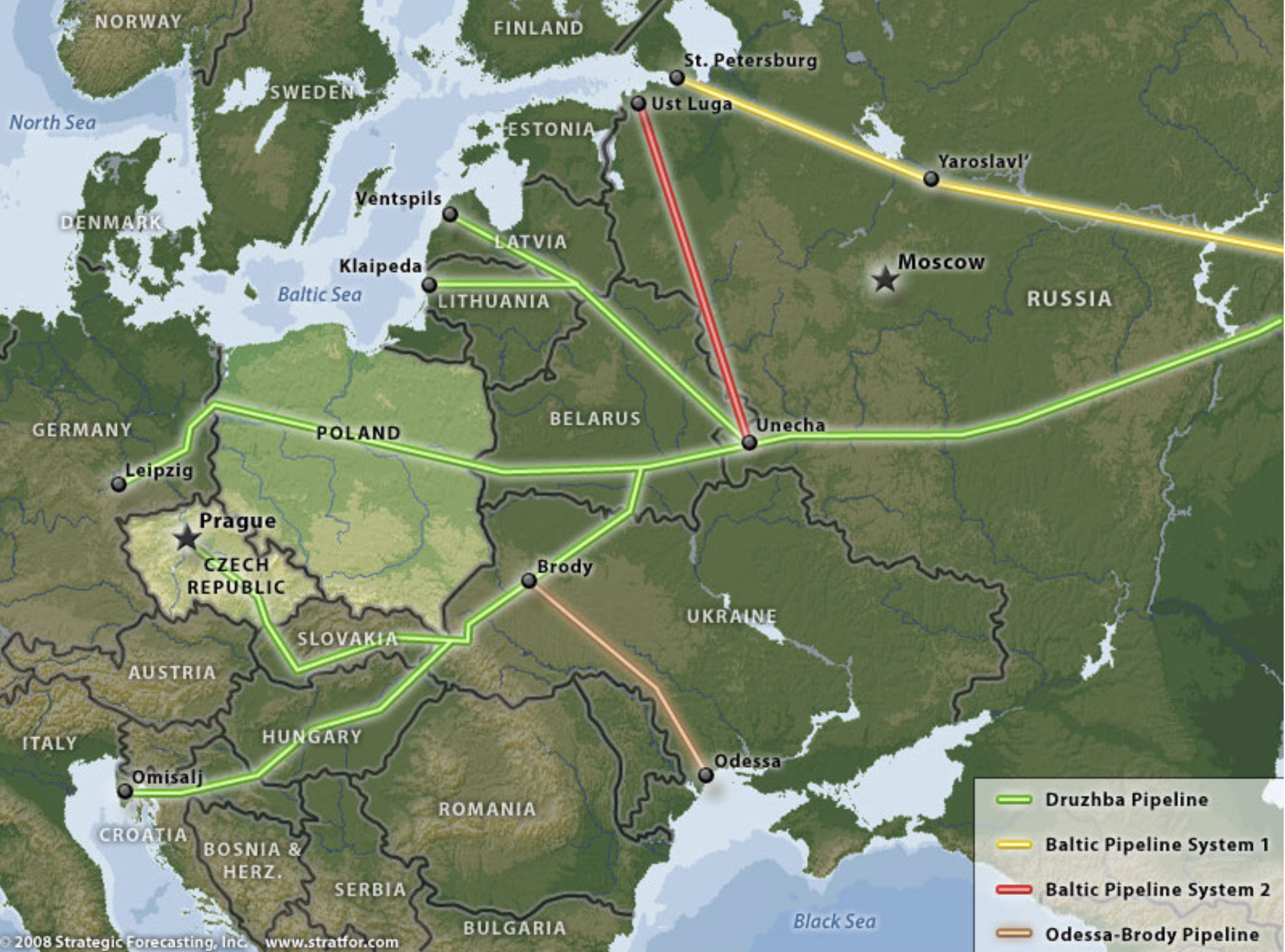 Source: Strategic Forecasting, Inc. (Stratfor). Green lines show the Druzhba pipeline; the Brody hub in Ukraine marks the southern branch’s main transit point.
Hungary and Slovakia are critically dependent on the southern branch. Both are landlocked, and their Soviet-era refineries — the Slovnaft refinery in Bratislava and MOL’s Százhalombatta refinery near Budapest — were built specifically to process heavy Russian Ural crude. Substituting other oil grades requires costly refinery modifications; finding alternative supply routes (e.g., through the Adriatic pipeline TAL/IKL or by sea to Croatia) would take months to scale.
On January 27, 2026, a Russian drone strike damaged pipeline infrastructure near the Brody oil hub in western Ukraine — the southern branch’s main transit point. Flows to Hungary and Slovakia halted almost entirely. On February 20, Orbán announced Hungary would veto the EU’s €90bn Ukraine loan until oil supply resumed. Slovakia’s government echoed the demand.
Ukraine, which collects transit fees on the oil flowing through its territory to EU neighbours even while at war with Russia, now faced a dilemma: allow Russian oil exports to continue — giving Moscow hard currency and EU members political cover — or hold firm and lose the transit revenue while antagonising two EU partners.
The Trade-Off That Broke the Deadlock
After Magyar’s election victory on April 12, the political calculus shifted. Magyar had stated clearly he would not maintain Orbán’s veto on EU funds for Ukraine. But he would not take office until May — and the loan required a unanimous vote of the current EU members.
Kyiv moved first. On April 21, President Zelensky announced the Druzhba pipeline had been repaired and could resume operation. On April 22–23, crude oil began flowing again to Slovakia and Hungary. Budapest and Bratislava confirmed deliveries had restarted.
EU ambassadors convened in Brussels within hours. On April 23–24, they gave preliminary approval to the €90bn loan package — the bloc’s 20th financial support package for Ukraine since the full-scale invasion began. Zelensky urged the EU to disburse the funds as quickly as possible; the majority is earmarked for defence procurement and front-line support.
What Changes Now
The loan itself matters, but the structural shift matters more. Orbán’s Hungary acted for years as Russia’s most reliable EU ally — delaying sanctions packages, blocking asset seizures, vetoing foreign-policy statements. A Magyar government aligned with mainstream EU foreign policy removes that leverage point almost entirely.
Orbán’s defeat also likely reopens the billions in EU cohesion and recovery funds that Brussels had suspended over rule-of-law concerns. Hungary had been losing roughly €1bn a month in frozen transfers; Magyar has indicated restoring those flows is a priority.
For Ukraine, the timing is acute. The war enters its fifth year with Western military aid under pressure from a shifting US political posture. A €90bn EU loan — much of it convertible to defence spending — represents a significant stabilisation of Kyiv’s fiscal position as fighting continues in the east.
References
- Hungary election results: Peter Magyar wins, Orbán concedes — CNN
- Peter Magyar wins Hungary election, unseating Orbán after 16 years — Al Jazeera
- Who is Péter Magyar, Hungary’s new leader? — Al Jazeera
- What Orbán’s ouster means for Europe — PIIE
- Ukraine restarts Russian oil to Europe, unblocking €90bn EU loan — Al Jazeera
- Druzhba pipeline restarts Russian oil flows to Europe — CNN
- EU envoys back €90bn Ukraine loan as Druzhba oil transit resumed — Kyiv Independent
- EU approves $106bn loan package to help Ukraine — NPR
- Druzhba pipeline — Wikipedia
- Péter Magyar — Wikipedia
- Hungary election: Orbán defeated — will Orbánism survive? — Chatham House
- 2026 Slovak–Ukraine oil dispute — Wikipedia